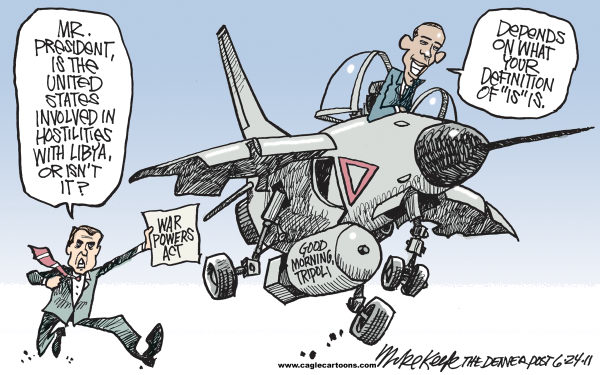
How did the Clinton and Obama Administrations justify their decisions to engage in military action without the explicit approval of Congress? Were you convinced by their reasoning?
PS OLC stands for Office of Legal Counsel, which is basically the President’s legal team.
 Constitutional Law (Powers): Spring 2020
With American military involvement in Bosnia under the Clinton administration, the House and the Senate did not offer a clear stance on this military engagement. The Clinton administration stated that it was the president’s power to “conduct U.S. foreign relations.” The administration also argued that the military action was for the good of the United States and Europe. They stated that Clinton had the power to act due to precedent set by previous presidents. They also argued that this military action was not war and therefore it was not explicitly a congressional power. Instead, they made the argument that this action was actually a presidential power under the War Powers Resolution as it gives the executive branch “the ability to initiate hostilities without prior congressional approval.”
The Obama administration was militarily involved in Libya. He wrote a letter to Congress explaining the situation but after 60 days had passed and he no longer held the explicit authority of the War Powers Resolution, members of the legislature said he was overstepping his bounds. However, the House and the Senate could not come to an agreement about what he should do. The Senate Foreign Relations Committee gave the administration authorization for a year to be involved in Libya. The Obama administration claimed that the president had authority for military action in Libya as long as it protected America’s interests and Congress did not explicitly stop him from acting. They also pointed out the precedent of previous presidents acting in military matters without congressional approval and stated that President Obama could act in Libya as it fell short of war. They also argued that because at least two nation’s interests were at stake and the goal was to ensure regional stability justified presidential force without congressional approval.
I have mixed feelings about the Clinton and Obama administrations’ reasonings. There certainly is a precedent set by presidents to start military action without explicit congressional approval and those presidents never faced significant consequences for doing so. The argument that neither administration was declaring or waging proper war and therefore did not need congressional approval was a strong argument. It is far more difficult to get a decision out of hundreds of people as opposed to just one person in the executive branch, so I understand why the president would want to act independently and I don’t think it’s necessarily wrong. However, I don’t find the arguments totally convincing because I believe it is giving presidents too much power without proper checks and balances. I think that the House and Senate are mostly to blame for allowing the president to have so much power. They struggle to see eye to eye and often cannot manage to agree on what to do about a President using the military without congressional approval so they usually end up doing nothing. Although a lot of the administrations’ reasonings make sense, they barely need to have them because the legislation does not seem to ever officially try to stop the president.
LikeLike
Excellent, Emma – and important that you’ve emphasized the theme of congressional inaction
LikeLike
Plainly, the Clinton and Obama Administrations were able to engage in military action without the explicit approval of Congress because they can. As Burns summarized, it isn’t difficult to understand why presidents don’t seek congressional authorization when armed with a “plausible reading of the Constitution, a great deal of legal precedent, and an increasingly docile Congress.” While this isn’t entirely the answer to your question, it is the foundation of these decisions. From the reading, Clinton seemingly had a passion for declaring his “constitutional authority” to initiate combat – citing his power to conduct U.S. foreign relations and his power as “Commander in Chief”. To be honest, both Clinton and Obama, at their roots, used the same ol’ excuses. Clinton’s OLC said that without the force of US troops, “the NATO force [would be] unlikely to be able to prevent renewed fighting.” On top of this, they threw in the whole “this will hurt America’s national interests” defense. His OLC also noted the “violence and atrocities” that Europe would face, the damaged credibility of the UN Security Council, and the diminished effectiveness of its peacekeeping mission. On top of this, they touched momentarily on the precedent that has been set by other presidents. More so, (and if I remember correctly), Clinton and Obama shared the justification that what they were doing did not amount to war as defined by the Constitution. Obama shared a more modern version of Clinton’s justifications: calling for action to prevent “humanitarian catastrophe” and to address threats posed to “international peace and security”, citing the possibility of Libyan instability leading to regional instability, and (wait for it) … noting the “dangerous consequences to US national security interests.” Obama notes his powers as the “Commander in Chief” to “conduct US Foreign Relations” (sound similar?). Maybe a little different from Clinton was Obama’s urge that his actions would be limited (they weren’t) – which like Clinton (if I’m understanding Burns correctly) was a tug at the War Powers Resolution (a tug since they were ignoring the part of “imminent threat”.
I’m not persuaded by their justifications because it feels tainted. It feels like somebody hit the copy and paste button on a *very* serious matter and that they can do so anytime without repercussions, which seems to be inching toward the core question of Burn’s piece.
LikeLiked by 1 person
Well put, Daniela! It’s useful that you’ve noted how the justifications recur over time in a “copy and paste”-type manner. I guess OLCs use this to say, “Look, we’re acting on precedent!”, but precedent might not be such a strong argument on issues of this gravity
LikeLike
In order for the Obama and Clinton administrations to engage in hostilities in Libya and Bosnia respectively, they had to bi-pass Congressional approval. The legal councils of both administrations devised similar arguments to justify their military engagements. Both administrations claimed historical precedent, citing examples of previous presidents who used the military to protect America’s national interest. For example, America’s use of the navy to open Japan to trade in 1853 or Johnson’s use of military troops in the Dominican Republic in 1965. Moreover, both administrations claimed that their military actions do not fall under the definition of war and therefore doesn’t encroach on Congress’ power nor require their approval. In their minds war constitutes a prolonged and extensive engagement. In the case of Libya since the military was using drone strikes and limiting the danger of US troops, these actions could hardly be defined as a war. On a constitutional basis, both administrations claim their authority from the implied powers of the Chief Executive and as the Commander in Chief. These powers allow the president to act unilaterally in the matters of foreign affairs as they are the best agents to respond to any form of threat, since the legislature would be too slow. Within this reasoning the executive is only limited by explicit constitutional restraints, which in this case only prevents the president from declaring war.
These arguments aren’t convincing and demonstrate how unchecked and expansive the powers of the executive are in the matters of foreign relations. The language in the constitution is clearly outdated and operates under the antiquated practices of war; a time when states declared war on one another. When the framers gave Congress the sole power to declare war, it is possible that they were referring more generally to the initiation of hostilities rather than the explicit declaration of war. I agree with many of the legislative supremacists, especially those that blame Congress and the courts for insufficient action to restrict the president. The courts claim that this issue is a political problem and thus they excuse themselves from deliberating on the matter. In all fairness even if the court made a ruling to end all hostilities, they can simply be ignored by the executive since they lack the power of the purse or the sword. Congress is more at fault, since they acquiesce and approve the military budget of the president. Even under the Trump presidency, whom every pundit called an unhinged manic, Congress still approves every military budget and does nothing to reclaim their constitutional war powers nor limit the executive’s war powers.
LikeLike
Although both the Clinton and Obama administrations engaged in military action without explicit consent from Congress, their justifications for doing so differed across the board.
To curb hostiles in Bosnia-Herzegovina during the Yugoslav Wars, Clinton initiated the use of airstrikes in the region — Serbian bombers were taken down in the process. In an attempt to vindicate these executive actions, Clinton claimed that his “constitutional authority” afforded him the power to engage in military action without the need for immediate congressional approval. The Office of Legal Counsel (OLC) corroborated Clinton’s assertion, adding that conducting U.S. foreign relations falls under his obligations as Commander in Chief. Moreover, the OLC further justified Clinton’s actions by declaring the United States’ promise to uphold peacekeeping missions in Bosnia at the behest of NATO and the United Nations (UN). If peace agreements between Bosnia and Serbia were to fail, the OLC argued, then the United States’ national interests would be “injured,” amongst other negative consequences.
Citing humanitarian intervention as justification, Obama initiated “limited military operations against Libya” in the spring of 2011. The OLC strengthened Obama’s claim by stating the president’s authority was rooted in his obligation to “protect national interests.” Moreover, the OLC reasoned that Obama’s military operations in Libya were also warranted given that Congress failed to obstruct his orders.
Speaking from personal opinion, I believe that, although void of the legitimate power to declare war, the executive branch should be able to act unilaterally to oppose, as per the War Powers Resolution, “a national emergency created by attack upon the United States, its territories or possessions, or its armed forces.” If a threat is imminent, credible, and has the capacity to directly injure the United States, the president should have the ability to take the appropriate measures accordingly and without interruption. As such, while I do not outright condone Clinton and Obama’s use of military action in Bosnia and Libya, respectively, I do not outright support them neither. Their justifications both appeal to me; however, at this time, I am wary of how endangered American national interests were as a result of the conflicts in Bosnia and Libya. Based on the reading, I am unsure if the threats made toward American sovereignty were imminent enough to elicit action without congressional approval. There is a part of me that believes that the actions taken in both Bosnia and Libya would have benefited from collaboration between the executive and legislative branches since no direct attacks were launched against the, to reiterate, “the United States, its territories or possessions, or its armed forces.”
LikeLike
Thanks, Eric – I’m glad you mentioned the war powers resolution. We’ll discuss this further in class today
LikeLike
According to Burns, Clinton justified his decisions to engage in military action without the explicit approval of Congress by telling them that his “constitutional authority” provided him with all the legal grounds necessary to engage in combat even though Congress did not provide him with their opinions. He argued that it was his power to conduct foreign relations and it was his duty as Commander in Chief and the OLC states that the president had the authority to exercise unilateral power due to historical practices. His administration was driven by more aggressive military approaches on war powers. In regards to Obama’s intervention, he argued that it was to prevent a humanitarian catastrophe and address the peace and security that Libya posed to the world. He believed that they threatened U.S national security interests and cited UN Security Council Resolution 1973 as authorization and Commander in Chief/Chief Executive to bring down Qaddafi assuring that this would be limited in scope and nature. I do not think their justification was convincing because Clinton exercised power that was beyond the scope of the limit of the President and he acted prior to discussion with Congress which could lead to wrong decision makings/move-in conducting an intervention without Congressional advice/approval. Although Obama argued it was to prevent a humanitarian catastrophe, intervention costs a large amount of money which hurts the economy if not successful and creates more conflict within the country so it is best to stay out of another country’s affairs unless it was threatening American people.
LikeLike
The Clinton administration justified their decision to engage in military action by stating that they were more cautious with aggressive military powers, unlike earlier presidents. Deploying troops is “no innovation” since there are long-standing precedents of presidents initiating hostilities unilaterally. Even while the U.S. had already introduced 20,000 troops for the UN Protection Force, the House and Senate still failed to produce a clear message for military action. This shows their lack of promptness during urgent times like war. This being said, I am convinced by the reasoning that Congress is slower in taking action and it is the executive’s role in ensuring self-preservation during emergencies.
The Obama administration was interested in the humanitarian front and preventing a threat to international peace and security. He used the UN Security Council Resolution 1973 as authorization and his executive powers to conduct foreign relations, but that his actions would be limited, and powers will eventually transition to other organizations. They also said that there was precedent of presidents using military force without congressional approval and that the president had legal authority so long as his intentions are to protect national interests. The House of Representatives eventually presented a resolution to remove American forces from Libya and it failed, showing, once again, the lack of solidarity and promptness in making decisions. There should be greater partnership between Congress and the executive instead of the executive making decisions unilaterally, but certain humanitarian and emergency issues can necessitate a uniliteral approach.
LikeLike
Clinton and Obama Administrations justified their military actions mostly by the precedent or actions of the previous Administrations. I believe that is a very political issue in which even courts decided to step away. I would really like to emphasize on the quote from the reading which states that one takes a stand depending where one seats. Truly, when Democrats start military actions Republicans are against it, and vice versa. On the one hand, I think their actions are justified because if previous presidents “started” such action then nothing should be on the way of succeeding president to do the same. On the other hand, the Constitution clearly defines declaring a war as a power of the Legislative. However, neither of them was technically declaring a war, so is this an another loophole of the Constitution? In my opinion, it clearly is.
LikeLike
Clinton did not actually “justify” his decision. Rather, he used presidential powers to engage in military action without the approval of congress. When asked if he would deploy troops without the approval, he stated, “I am not going to lay down any of my constitutional prerogatives here today? (211) and his legal team agreed with him, thereby supporting his statement. The OLC then went on to provide justification for Clinton’s position by stating, “without this substantial contingent of United States troops, the NATO force is unlikely to be able to prevent renewed fighting in Bosnia,” (211) Without this show of force by the USA (without explicit approval or otherwise), the OLC suggested that it would place the US and allies like Europe at a danger for “violence and atrocities” not seen since World War II. Though a softer approach than the previous Bush administration, whereas Clinton sought peace and not exactly war outright, “like all OLC lawyers and Attorneys General over many decades—were driven by the outlook and exigencies of the presidency to assert more robust presidential powers” (211).
This was also true during the Obama administration where there were strikes on Libya simply because there was a concern for between national security and U.S. actions in Libya” ( 215). In this instance, similarly to Clinton’s administration during the war on Bosnia, there was no known link to extremist groups. The intelligence provided as a justification was just as loose as Clinton’s use of presidential powers over Bosnia. In my opinion, there was neither a solid justification in either situation or clear examples of why war the kind of military action that was imposed on these governments was allowed. The loose and convenient translations of the Constitution based on whoever is in power is also very problematic as the OLC seems to hold up decisions made by presidents and their independent power and not congress. The result is a lack of fixed rules giving the “political process” more control over policy than the text of the Constitution” (218).
m.jenniferbernard@gmail.com
LikeLike
Both the Clinton and Obama administrations used “imminent threats” as justification for not seeking Congressional approval. Clinton argued the consequence of ignoring the situation in Bosnia would lead to instability in Europe and therefore the U.S. Obama brought up national and international security concerns but doesn’t say much else. Which seems to be the pattern for both Presidents. They simply say that if they are not given control of military forces, then WW3 will happen. Another justification is explicitly provided by the Clinton administration is precedent. Clinton’s OLC points to multiple presidencies that used military action without Congress’s direct approval. While the reading doesn’t give details about those actions, I’m sure those administrations used humanitarian and national security as justification. None of this is convincing. First, humanitarian violations and national security are issues that should be raised by Congress when deliberating a declaration of war or an AUMF. Also, Clinton and Obama never provided facts to back up their claims. While the President can also bring up these issues at the table as Hamilton’s view of the executive suggests, the decision is ultimately with Congress. Second, the problem with precedent is that you assume the previous decision was correct and applicable to the current situation. Both administrations fail to recognize that they have only part of the puzzle, reasonable justification. Assuming there concerns were just they miss the other side, which is a proper procedure, which means getting Congressional approval. Neither Clinton nor Obama used proper procedure, and therefore there reasoning, good or bad, is not convincing.
LikeLike
Thanks for this Kalel – I’m glad you mentioned the “imminent threat” justification and had it in quotation marks. As we’ll see more on Wednesday, this concept has been defined rather elastically during the War on Terror: https://theintercept.com/drone-papers/the-kill-chain/
LikeLike
The Clinton and Obama Administration justified their decisions to engage in military action without the explicit approval of Congress by arguing that the President already has the power as commander-in-chief to do so and the timeline of these conflicts are not considered “prolonged” or classified as war. The US had to “intervene” in Kosovo, Bosnia and Libya in order to establish some sort of order and combat the “evildoer” causing suffering among their people. Plus, the US is the strongest country in the world and most people believe that they have a responsibility to intervene in humanitarian crisis’.
I am not convinced of their reasoning because although both Obama and Clinton have argued to intervene in humanitarian crisis’, it can backfire on them and create complex problems like in Libya or Kosovo. In both circumstances, Congress has not responded to the Presidents doing this, which is a problem even though the President found a loophole around them.
LikeLike
Under the Clinton administration unfortunately war power was clearly in the executive’s hand rather than in Congress power. I would have to say perhaps his personal bias is what he followed when conducting these attacks. There is no plausible justification. He was clearly influenced from Truman’s experience and seems to be on going off a personal agenda. It was clearly a tactic used to cover up scandals which are irrelevant and demonstrate a failed leader in charge. An example of this has to do with the peace talks between Yugoslavia, and other nations including the U.S. this was to distract press about Clinton’s rape allegations. To postpone his impeach he once again bombed Iraq claiming non cooperation with UN inspectors. Clinton violated the constitution and disregard common laws established to maintain peace regardless of the legal binding.
It’s ironic how Obama critiqued George W. Bush about his conduct of wars in Iraq and Afghanistan. He also claimed that under the constitution no president is authorized a military attack without stopping an imminent threat to the nation. Clearly, he was aware of the presidential role prior to becoming one so he should have had a more convincing reasoning.
The Obama administration released a memo after the military operations were in placed explaining it to be temporarily. Also, claiming for the scope of this to be minimum opposing any war. This is not plausible because war this action caused destruction and implemented fear to civilians and was an attack. With this being said, Mr. Obama did violate the Constitution. Not only did he lie about the length of the period he used military force which is not under his authority to do so. I do believe there should be transparency about a possible war in collaboration with Congress to make such decision even if the situation seems minimal. Just as a protocol to follow. The founding fathers when writing up the constitution thought of possible encroachment of branches and wanted to prevent it through an equal balance of checks and balances. Congress needs to enforce their power and be able to stop such acts from continuing because this role has been a continuous cycle beginning from Truman. The president does not have power to begin a war and presidential supremacy should not infringe on the power of Congress. This creates animosity and an inconsistent pattern of behavior diminishing the system of checks and balances and the authority Congress holds.
LikeLike
In 2011, the Obama administration decided to intervene in the civil war occurring in Libya. Obama wrote to Congress saying that his operation in Libya would be rapid and limited. But after 60 days, Obama was still sending airstrikes to Libya and sending asserts to the rebel group. He did without Congressional approval.
Obama claimed that his actions in Libya were constitutional because he did it to protect national interests and that Congress did not specifically restrict him from doing the things he did. Obama also claimed that he had the constitutional right because he was the commander in chief and he had the right to conduct U.S. foreign relations.
In 1995, the Clinton administration decided to intervene in the ethnic massacre that was occurring in Bosnia, Serbia. The United States sent airstrikes to Bosnia without the approval of Congress.
Clinton also claimed that his actions in Bosnia were constitutional because he is the commander in chief of the army and he has the constitutional right to conduct U.S. foreign relations.
I agree that both Presidents had the right to intervene the way they did because of their jurisdiction over U.S. foreign relations. I don’t think they needed Congressional approval because they did not explicitly declare war. The Constitution grants Congress the right to declare war, so as long as both presidents intervened without declaring war, I believe that what they did was not unconstitutional. In Obama’s case, he actually made Congress aware of his actions which I think was a good thing. Both Clinton and Obama acted in cooperation with an international organization like NATO and the United Nations, so that makes their actions fall under foreign relations.
LikeLike
I wrote an in-depth response previously I don’t know if it went through or not. The prompt said I couldn’t leave a comment. Briefly, Clinton justified his actions by cited as Commander in Chief he is allowed to take action by helping NATO enforce a no-fly zone. He also had a right to conduct US foreign relations. He also state precedent was on his side. (Navy opening up Japan) and in 1965 armed forces into the Dominican Republic. If the peace agreement failed it would injure the uS national interest. Obama cited to prevent a humanitarian crisis for going into Libya and for international peace and security. He also wanted to prevent instability in the region. Obama also used the authority to conduct foreign relations on behalf of the United States. Congress’s inability to act leads Presidents to exercise more power. The government has three branches thereby allowing one branch to resist and challenge the other. The Courts will not decide on anything political their way of avoiding hard questions. Unless it is a question that reinforces their ideology. Avoiding the invitation to struggle fits nice and neat for the legislative and judicial branches. Neither wants to deal with any blowback from a decision they may have to decide.
LikeLike
The Clinton administration first reported to Congress about Bosnia citing, ‘congressional authority’ granting Clinton with the authority of using legal grounds to initiate combat. Clinton justified his decision in engaging in military action without congressional approval by using the power of Commander-in-chief. Clinton had that power because it is specified in the constitution that commander-in-chief has the power to deploy troops. “The OLC stated clearly that “[t]he President has determined that, without this substantial contingent of United States troops, the NATO force is unlikely to be able to prevent renewed fighting in Bosnia” (211). With the situation in Libya, the Obama administration cited the “UN Security Council Resolution 1973 as authorization and his powers as “Commander-in-Chief and Chief Executive” to “conduct U.S. foreign relations”” (213). He justified this reasoning by saying that this action can help prevent a humanitarian disaster as well as a prevention to the threat of international security and interests of the United States. “The OLC deepened and strengthened the legal claim. It stated that Obama had the authority as long as he did so to protect national interests and provided that Congress had not “specifically restricted” him from acting. The OLC went on to say that presidents had used military force throughout history without prior congressional approval, claiming that “historical practice is an important indication of constitutional meaning”” (215). I am not convinced by any of their reasons as to why they did what they had in both Bosnia and Libya. Their decisions make them look bad in the eyes of the public and would serve no interest for America. To the masses, it is the consistent turn of sacrificing American lives and wasting money to get involved with foreign countries and their issues.
LikeLike
Both Clinton and Obama used historical precedence to justify their choices to engage in military action. Clinton claimed to use his power as Commander-in-Chief to intervene in Bosnia and saw it as just conducting U.S. foreign relations. I would like to point out the different political situations in both the Clinton and Obama cases. Clinton was dealing with a humanitarian issue where Serbian forces were engaging in the ethnic cleansing of Muslim Bosnians at the time. So I am somewhat convinced of Clinton using the U.S.’s commitment to NATO and the UN to send troops in as peacekeepers and prevent what was basically a genocide. However, Obama did not seek approval from Congress and used military action to help overthrow a foreign nation’s government which I see very little justification for. It was unnecessary, there were no issues with national security or interests and Congress should have actively exercised their constitutional power and prevented him from overstepping that boundary and interfering in Libya. Here, this was not a humanitarian issue where the country was bound to international commitments and nor were there any threats to national security. As stated in the passage: “Chris Edelson writes, “Congress had not authorized the use of military force and Libya had neither attacked nor threatened an attack against the United States or U.S. forces.”73 Hendrickson notes that there was an opportunity for Congress to assert itself, but it decided “to follow Obama’s lead and avoided questions surrounding the constitutionality of the president’s conduct.”
LikeLike
The Clinton Administration’s justification for engaging in war without congressional approval is based on several reasons. The first argument that the OLC used for Clinton’s engagement in Bosnia was that without the US support the NATO can not stand on its own. Second, the OLC used past presidents’ actions in war as precedents which allowed Clinton to do the same in Bosnia. The OLC used NATO’s agreement to showcase how the organization itself does not promote war. NATO aims not to use force and take over territory which means the US cant engage in war because there are no hostilities; thus, Clinton is not overstepping on congressional powers, which makes Clinton’s actions constitutionally valid. Lastly, the War power Resolution clause gives the president the authority to start a war without congressional approval.
The Obama Administration began a humanitarian logic stating that the administration had to act to prevent catastrophes in Libya and that the constitution allowed him to act. Also, the president’s action was minimal, not constituting as calling an act of war. The administration went as far as to even shove it in Congress face that they did not attempt to stop him.
I absolutely, for the most part, don’t agree with the presidents’ justification for engaging in war. I see their arguments as highly manipulative, bold and as an act of tyranny. Although I agree with their justifications, I agree with the author in stating that congress enables the president’s overreaching executive power by not restricting them. It is congress’s authority to write law and it seems to me that congress is more worried about partisanship and tradition than the possible outcomes of the presidents engaging in tyranny.
LikeLike
The Clinton and Obama administrations justified their decisions to engage in military action without explicit approval of Congress by stating that it is “humanitarian intervention” rather than war. The administrations “follow Yoo by acting unilaterally and producing constitutional arguments to support those actions”(Burns). Clinton reported to congress that his “constitutional authority” allowed him all legal ground to initiate combat in February, 1994 when the U.S. forces shot down Serbian bombers. Clinton consistently asserted his power ” to conduct U.S. foreign relations” and his power “as Commander in Chief”. The OLC stated that it is in America’s national interest to engage and prevent hostilities. “According to the OLC, the War Powers Resolution actually reinforced this interpretation by giving the president the ability to initiate hostility without prior congressional approval within a certain window”. Obama’s administration justified their decision to engage in military actions against Libya to “prevent a humanitarian catastrophe and address the threat posed to international peace and security by the crisis in Libya”. In his letter to congress Obama linked Libyan instability to instability in the region to claim how it had “dangerous consequences to the national security interest of the U.S”. The OLC stated that Obama had authority as long as he did so to protect national interests and provide that Congress had not “specifically restricted” him from acting. The OLC also claimed that presidents have used military force throughout history without prior congressional approval. Lastly, the OLC argued that the operation in Libya fell short of war.
I am not all convinced to their arguments because the administrations framed it as a “humanitarian interventions” when really they’re military interventions.
LikeLike
Hello. I didn’t realize we had a blog post last week. I didn’t download the updated syllabus even though I know it was updated for the recalibration period. It slipped my mind to download the new one, and since it had the same title, I didn’t realize the dates shifted.
Clinton justified his actions for deploying troops in Bosnia because of the establish historically. He didn’t infringe on the powers of Congress in doing so. Obama defended his military intervention because of a possible threat to national security. To a certain extent, I agree with their reasoning because both understand that the practice of using military power can use a means to deter tyranny and civil war in the future. For example, say 30 years down the line a state in the Middle East wants to take over the other surrounding countries. Invading states would need to think twice about starting a civil war, genocide, or committing acts of terror because it has been established that the United States will not tolerate such crimes. The U.S. President has the prerogative to intervene, but whether they decide to do it for the people, the nation, or their agenda would be the primary concern.
– Martin B. 4/20/2020
LikeLike