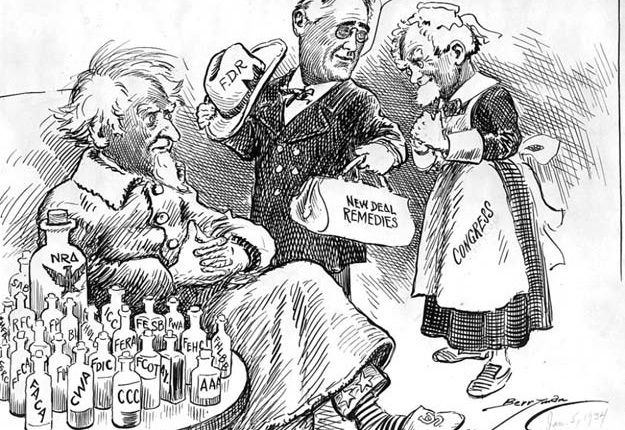
As I warned you, the reading is tough. There are two main things I want us to get our heads around:
1) Arkes cites Antonin Scalia’s view that “the Congress has the authority to make laws, not legislators.” Why do you think he emphasizes this point so much, and why is it relevant to the New Deal?
2) What are Arkes’s criticisms of how the New Deal affected the Commerce Clause? [Hint – a bit of control-F might help you get to this quickly]
On both of these questions, we will discuss counter-arguments in class – try to start thinking of some here.
 Constitutional Law (Powers): Spring 2020
In paraphrasing Justice Scalia, Arkes notes, “The [C]onstitution gives the Congress the power to make the laws, not the power to make the legislators” (4). This remark speaks to the greater point of Arkes’ essay “Was the New Deal Constitutional?” regarding the pervasion of corporatism throughout the federal government. Arkes’ criticisms toward corporatism—state control as assumed by large interest groups or other organizations with common goals and interests—stems from the New Deal actions Franklin D. Roosevelt took during the Great Depression as a result of legislative power being delegated to him by Congress. Arkes refers to this delegation of power as a, for lack of better term, manipulation of the Constitution, particularly the specific authorities it assigns each of the three branches of government. He persuasively illustrates this New Deal-era corporatism with the following passage:
“With the [National Recovery Act], and other, novel forms of regulation under the New Deal, the Congress would transfer its legislative power to the [e]xecutive, who would then delegate it in turn to councils… We would have, then, councils composed of businessmen and unions, which would be authorized then to exercise the monopoly powers of law in enforcing codes of ‘fairness’ in pricing. Which is to say, the would be armed now with the powers of law to forbid their competitors to undercut them.”
“Acts of Congress” (quotations added to emphasize Arkes’ sarcasm) passed under the New Deal, including the National Recovery Act (which Arkes makes explicit reference to in his essay) were, at their core, not constitutional legislative regulations. The powers of Congress, due to corporatism Meddling in the affairs of the federal government, were corrupted and ultimately passed down to Roosevelt and private councils. Monopolization of certain commodities was one of the private councils’ modus operandi, which was perpetuated under the guise of “acts of Congress.” This all ties into Scalia’s aforementioned remark that Congress is constitutionally responsible for making laws and not other legislators—the legislators in this case being the executive and private councils (or, broadly speaking, parties not directly belonging to either the House of Representatives or the Senate).
To place all of this into the context of the Commerce Clause—the constitutional enumerated power delegated to Congress “[t]o regulate Commerce with foreign Nations, and among the several States, and with the Indian Tribes”—said power was broadly expanded to reach private companies. To quote Arkes, “… a willingness of the [Supreme] Court to accept an expansion of the federal government under the Commerce Clause, in protecting unions, and in regulating the conditions of employment and compensation” (14). He claims that the Commerce Clause and its powers were so widely interpreted and overestimated that, eventually, it made it easy private council attorneys to defend nefarious acts of corporatism in courts of law—even when said defenses were paper thin.
LikeLike
Political power can be corrupted when Congress’ inherent law-making power is delegated to several factions. The New Deal permits the Executive branch to hold legislative power transferred from Congress, which is then transferred to separate factions. In short, the Executive branch has a disproportionately high amount of power in relation to the other branches. It can implement law that is divorced from “any broader, governing principles.” In Congress, there would be a public arena that argues for several interests and challenges to the proposed new law, but the New Deal undermines that democratic aspect of Congress.
The New Deal expanded the federal reach of the Commerce Clause. It was an expansion of the federal government that had effects on everyday life. There were also moral concerns that were meant to be handled by Congress, in that there was a responsibility for Congress to decide whether which commerce laws were legitimate and illegitimate and other economic issues. The federal encroachment on personal privacy, as seen in the possible justification against abortion, is concerning to Arkes. He was worried that personal privacy would be in the hands of the federal government and that the New Deal allows stringent regulations on abortion. Once again, it is a problem regarding federal encroachment on states and individual lives.
LikeLike
Antonin Scalia’s comment on Congress states that Congress should not delegate its powers over to the executive. Arkes uses this point to criticize the FDR and his use of executive power. During FDR’s presidency, he tackled the Great Depression with numerous acts and regulations that virtually resembled legislation. The problem with these regulations, regardless if they worked or not, is that they are authoritarian in nature. Whenever Congress tries to implement a new piece of legislation, they have to undergo a serious amount of deliberation. FDR’s New Deal policies were exempted from deliberation, as thus they were more susceptible to the corrupting influence of special interest. Congress is better suited to combat special interest since deliberation causes special interests to compete with one another, as stated by Madison in Federalist 10.
Arkes also criticizes FDR’s New Deal policies for expanding the interpretation of the Commerce Clause. The federal government now had the legal ground to intervene in the affairs of private businesses. Even though New Deal policies, like a higher minimum wage, may have appeared to be necessary during the Great Depression, it would set the justification for future expansion of government intervention. The federal government could justify its intervention on issues like abortion or civil rights on the newly expanded view of the Commerce Clause. Arkes provides the example with Professor Laurence Tribe, who argued that the federal government could legislate the right to an abortion based on the commerce clause. Since anti abortion laws in some states encouraged women to travel to other states that allow abortions, Congress can legislate the matter since a “business” between states has been created. This new view of the commerce clause is unconstitutional as it significantly expands the powers of the federal government over regular people, which was not the original intent of the framers.
LikeLike
Even though there were a few paragraphs I had to read a couple or even a few times, I found this reading very interesting. It made me think of the issues that I had a very different perspective on. Especially when the author connected Commerce Clause and abortions. I probably read that paragraph five times to fully comprehend how he connected these two very unconnectable, in my opinion, things.
To the point of Justice Scalia, who said that legislators are not making the law, but Congress does, it sounds absurd to me when I just read the text. Truly, there are synonyms to the word “Legislator” such as lawmaker, lawgiver, and so on. This would definitely confuse anyone who does not read between the lines. However, what I think Justice Scalia really meant to say here is that the powers granted to something as a whole are not granted to the parts of the whole. Otherwise, people should not think of one or another member of Congress as a powerful tool to reach a specific goal, but rather of Congress itself. Therefore, I believe with this statement he emphasizes that the details do not matter as much as a product as a whole does. Maybe, but I am not sure about it, he is also pointing out the nine Justices as members of the SCOTUS and SCOTUS as the institution itself.
The unconstitutionality of the New Deal mostly relies on schemes of corporatism and the regulations, as the author puts it. In fact, federal intervention in the business of the state is the very first point that screams about the unconstitutionality of this deal. The author pointed out that questions of constitutionality may sometimes be separate from the power of the courts. This is where it gets really scary, what is the purpose of the whole division between three branches of the government if they are not controlling each other then? The New Deal basically presented one of the very first ideas in America about democratic socialism, which I think is strongly followed even today by some Democratic officials.
LikeLike
Thanks, Kate – this is a great response. I’m interested in your final point about democratic socialism. Certainly, many of today’s democratic socialist’s cite FDR as their model, but, in some ways, the New Deal involved many elements that were neither democratic nor socialist. Indeed, Arkes’s term is “corporatist”, by which he means technocratic attempts to build cooperation between labor and capital. On the other hand, democratic socialism would almost certainly require the corporatist/bureaucratic elements… A very intriguing question!
LikeLike
1) Arkes cites Antonin Scalia’s view that “the Congress has the authority to make laws, not legislators.” Why do you think he emphasizes this point so much, and why is it relevant to the New Deal?
Arkes emphasizes this point so much because he states from Aristotle’s Politics that politics was corrupted when political power served the private interests of the rulers and Congress transfer their legislative power to the executive which was then given to the council meaning that this would create monopolies on fairness because the council was made of businessmen and unions which robs the common people of earning a livable wage. This enabled the monopolies and unions to prevent laws that allowed their competitors to undermine them. These actions would affect the general public. Using Scalia’s view, he meant that Congress can make laws, but not decide what is just or not just. It is relevant to the New Deal because FDR wanted to pass this and wanted to pack the court with justices who supported his position without his policies being considered unconstitutional meaning that FDR would have more power over Congress. The one who decides whether a law is the Supreme Court, not Congress who tries to reason with the court.
2) What are Arkes’s criticisms of how the New Deal affected the Commerce Clause? [Hint – a bit of control-F might help you get to this quickly]
Arke’s criticisms of how the New Deal affected the Commerce Clause is that there was the issue of foreign and military policy with the Soviet Union as the Roosevelt administration accepted the validity of some Russain decrees with Russian companies that had assets in the United States. It came under the takings clause and the court counted it as a sensitive topic in domestic affairs. Justice Sutherland pointed out that the State of New York does not exist in the case of Curtis v. Wright, but Arkes argued that politically, Justice Sutherland’s argument does not stand. In resisting the New Deal, the court did not have any dissent in the Schechter case or the Louisville Bank v. Radford struck down the Frazier-Lemke Act to relieve the farmers debt. When the Commerce Clause was engaged properly, it could affect many aspects of our daily lives, but the expansion of this clause was that people used it on its rationale that does not have a plausible reasoning.
LikeLike
Scalia’s emphasis of his view that “the Congress has the authority to make laws, not legislators,” reflects some of the politics of the New Deal and specifically the National Recovery Act (NRA). The National Recovery Act put political and legal power in the hands of people who were not politicians, allowing them to legally penalize their competitors who went against regulations and lowered prices. These people were not legislators, and Congress could not do anything to make them like legislators, but Congress could and did give them legal power through the law.
Arkes criticizes how the New Deal expanded the Commerce Clause. The author argues that the New Deal gave the Commerce Clause such a wide reach to the point where it could control the mundane areas of peoples’ lives. Arkes takes issue with how unregulated and “untethered” the Commerce Clause has become. It could be argued that everything from abortion, traffic violations, or discrimination against African Americans could fall under the Commerce Clause. The expansion of federal regulation under the Commerce Clause allows the government to control practically every aspect of a person’s life.
LikeLike
During the New Deal, the Executive was given an increasing amount of authority through legislation. These pieces of legislation weren’t designed to address problems but rather allow the President to address problems. Arkes cites Justice Scalia’s view because of what happened during the New Deal was the creation of legislators in the executive, not legislation. Broad, unspecified pieces of the law put the President in a position to cut off the arguing of interest and justifications. They get all the responsibility including the blame. Arkes criticizes the expansion of the Commerce Clause and how it was justified. He reasons that it was already a powerful instrument for federal regulations. During the New Deal, it was expanded by the Court to affect any business from a local deli to a national insurance company. Since the Commerce clause relates to economic activity, Supreme Court opinions should mention economic theories, studies, etc. However, the Court’s justification didn’t include any of that and rather mentions necessity and moral concern. The Commerce Clause was interpreted to go beyond commerce but also became intertwined with civil rights and abortion. It became a tool to allow greater federal involvement in areas it was not normally accepted.
LikeLike
What I get out of this statement is that private actors shouldn’t be involved in the legislative process. Congress has the authority to make laws, but they don’t have the authority to pass those powers onto private actors with special interests. If I’m understanding the article correctly, it seems relevant to the New Deal because you have private interests dictating what the public does – as evident by the introduction where Arkes discusses the case of Maged.
Arkes discusses the “extended reach of the Commerce Clause” and how when utilized properly, it has the potential to reach many aspects of our lives. He gives an example of the sale of wine in NYS from local vineyards and that the “privilege would not be extended to wines produced outside of the state”. This sort of power expanded in its breadth, and as he notes, the concern became that this ability was “untethered”. He goes on to discuss the moral concerns behind this movement – “the difference between the legitimate and illegitimate”. It seemed to be that the Commerce Clause could “justify extensions of federal power to the smallest, most prosaic enterprises.”
LikeLike
Arkes cites Antonin Scalia’s view that “the Congress has the authority to make laws, not legislators.” The reason why Arkes emphasize this point so much is that he wanted to demonstrate the enormous amount of power that was granted to the President. Power was given to Congress to make laws and yet, we had a President whose power expanded beyond what was ranted. Arke’s asked questions like ” Was the New Deal Constitutional’?.The legislation of the New Deal expanded the Commerce Clause which even gave the expansion of the interference into the private sector. It was involved with people’s everyday problems. The congress gave so much power to the president that he thought it was ok to interfere with private businesses.
LikeLike
Arkes cites Antonin Scalia’s view that “the Congress has the authority to make laws, not legislators.” The reason why Arkes emphasize this point so much is that he wanted to demonstrate the enormous amount of power that was granted to the President. Power was given to Congress to make laws and yet, we had a President whose power expanded beyond what was ranted. Arke’s asked questions like ” Was the New Deal Constitutional’?.The legislation of the New Deal expanded the Commerce Clause which even gave the expansion of the interference into the private sector. It was involved with people’s everyday problems. The congress gave so much power to the president that he thought it was ok to interfere with private businesses.
LikeLike
(1) Arkes cites Antonio Scalia’s view that “the Congress has the authority to make laws, not legislators. ” Why do you think he emphasizes this point so much, and why is it relevant to the New Deal?
Arkes emphasizes Scalia’s reference to the ability of Congress to make laws not legislators using the examples of first, the dry cleaner who charged $0.35 instead of $0.40 and was thrown in jail for not charging according to the mandate issued by the National Recovery Act. Second, he provides another example in the case of “Hot Oil” where Congress delegated to the President “the authority to prohibit the transportation in interstate commerce of petroleum and petroleum produced or withdrawn from storage in violation of the quotas that may be prescribed in any state, ” (Arkes, 5). However, each state could issue its own quotas of the “hot oil” making one amount illegal here and the same amount illegal in another place. His third example is the imposition of taxes on abortion itself. “If the federal government could not legislate by indirection, through the manipulation of taxes, (Arkes, 7).
The relevance of Scalia’s comment and Arkes use of it as it relates to the criticisms of the New Deal is provided in a clear example of Lincoln and his observations on slavery. Lincoln did not believe that the generals should be left to “fix their permanent future condition” but rather the laws (Constitution) and lawmakers would need to prevail the order (Arkes, 12).
(2) What are Arkes’s criticisms of how the New Deal affected the Commerce Clause?
Arkes has many criticisms of how the New Deal affected the Commerce Clause.
Given the previous involvement of the Federal Government in local affairs such as with the New Deal, the Commerce Clause was another reach that came from the New Deal. Arkes uses the example of Cuomo’s encouragement of the sale of wine from local New York vineyards by allowing supermarkets to carry wines. However, he did not allow the same privileges to wines that we were purchased outside of the state. “There is the unambiguous presence of a law, which barred the sale of products or services coming from outside the state, ” (18). Arke goes on to use again the case of abortion in which the Commerce Clause was a model for the “flow of transactions” but rather it was for the purpose of finding a formula to limit federal power (19).
LikeLike
Arkes cites Antonin Scalia’s view that “the Congress has the authority to make laws, not legislators.” twice in this text because it highlights the danger of giving the executive office or local officials the power to create laws and enforce them without the congressional scrutiny that it usually entails. This scrutiny protects the many interests over the favor of the few. This is relevant to the conversation about the New Deal when considering the unchecked power given to FDR in the NIRA(1933), to regulate commerce. A power he used to set wages and price regulations. These regulations were left to councils with special interests in the private sector to manage their own markets. This authorized them to set the market up in their favor and incapacitate a competition’s ability to offer competitive pricing. This power was awarded to the president in the wake of the Great Depression to combat the failing economy using a far reaching interpretation of the Commerce Clause. Arkes asserts that the New Deal manipulated the Commerce Clause to sanction its power play during a national emergency. He criticizes the lasting effects of the New Deal on the Commerce Clause, accusing it of supporting a welfare state and dealing in social insurance. He also points to the lengths that the Commerce Clause has stretched to satisfy liberal social issues. Arkes points to the dangers that could arise from manipulating the constitution to sanction federal intervention in state affairs.
LikeLike
From my understanding, what Justice Antonin Scalia is saying the power to put laws into fruition does not allow for people in congress to be bigger in stature than the position they hold. The New Deal was to counteract the effects of the Great Depression by creating public interest programs like social security and health care programs. It is relevant to the New Deal since the new deals propose was to create programs it allowed congress to be associated with the affairs of making law.
The commerce clause gives the ability to tell the country when they can and cannot trade with other foreign countries. This clause is very significant because it framed the groundwork for our foreign trade today.
LikeLike
Arkes emphasizes the point about Congress’s authority of “making laws, not legislators” by indicating that Scalia meant that power of Congress comes from the people who elect them. Any laws therefore should be in the best interest of the people or society, not in the best interest for themselves or political party they affiliate.
Arkes criticizes the New Deal’s affect on the Commerce Clause because the federal government’s power extended now to private businesses. The acts and regulations from the New Deal, became a burden to business owners who would be punishment and/or fined for violating these acts.
LikeLike
-Martin Bueno
LikeLike
Hadley Arkes emphasizes Justice Scalia’s originalist theory of constitutional interpretation “the Congress has the authority to make laws, not legislators.”
This is relevant to the New Deal, because it is an enumerated power granted to Congress under the constitution. Under FDR this power would be corrupted since Congress would transfer its legislative power to the executive. Corruption would rise by the president, through delegated powers to councils embodied of businessmen and unions, allowing them power of law over their competitors. This was viewed in the Coal industry at the expense of smaller firms without any justification. Corporatism was being formed against ordinary people which is the opposite of what the New Deal claimed to aim at which was Relief, and Recover. In regards to reforming it differently did reform the power of the executive, the federal government interference in State laws, and the packing of courts. This is why the author Arkes emphasizes Scalia’s constitutional interpretation. The importance of the interpretation is that Congress has the power to create laws, not the power of creating legislators who will make their own laws without any justification rendered. This is when the New Deal becomes unconstitutional because the discipline of the American Constitution would be gradually dwindled. The discipline of the constitution would dwindle because the President can authorize a code to exempt a particular group or to mean differently in each state. This gap leaves room for controversy as viewed in the Panama Refining Co. V. Ryan. Different States would calculate different quantities of barrels of oil a day and in one state a greater amount can be illegal. Under the NRA the president was authorized the transportation of petroleum in any States. Clearly, the granting of this power violates the Sovereignty each state has in regards to interstate commerce. This is a greater issue that is perceived for the interest of the President rather than for protection of property.
The New Deal affected the commence clause because Federal government had regulatory power over State economy’s. Many States also used the commence clause to discriminate against race, gender and for economic purposes.
LikeLike
1) Arkes cites Antonin Scalia’s view that “the Congress has the authority to make laws, not legislators.” Why do you think he emphasizes this point so much, and why is it relevant to the New Deal?
2) What are Arkes’s criticisms of how the New Deal affected the Commerce Clause? [Hint – a bit of control-F might help you get to this quickly]
LikeLike
“The Congress has the authority to make laws, not legislators,” is emphasized greatly to show the 73rd Congress’ bias to favor The New Deal, is that the majority of legislators was comprised of Democrats. During the New Deal, specifically the First 100 Days, Congress approved and passed all of Roosevelt’s policies, almost without any hesitation. Being that the legislators were all Democrats, they indeed favored the Keynesian esque approach FDR was taking with the New Deal, essentially why Arkes would endorse Scalia’s claim of basically Congress being swayed by one-sided legislators rather than considering actual methods to uplift the United States from the depression at the time. Arkes states that the New Deal expanded the Commerce Clause and fueled the extension of the federal government’s power. One of his critiques includes the Wickard v. Filburn, in which a farmer was being punished for saving a portion of his wheat for his own family. Ultimately his examples, along with several others, show that the New Deal’s objective to meet liberal ends has caused the Commerce Clause to grant the federal government too much power, which is in disagreement with his much more laissez-faire approach.
LikeLike
1) Arkes’s emphasizes this point so much and is relevant to the New Deal because with regulation under the New Deal, Congress would transfer its legislative power to the Executive, the President, who would be free to input regulations. He believed that constitutional discipline would be evaded entirely if the President were free to pluck regulations out of the air.
2) Some of Arkes’s criticisms of how the New Deal affected the Commerce Clause are “that Congress would be legislating in a field in which it bore no clear authority to legislate”, through the manipulation of taxes. The New Deal was created to pull the U.S from the great depression, thus using the excuse of the Great Depression to allow the government to regulate the economy in a form of taxation. Even local businesses would be affected by currents of the world economy.
LikeLike
The New Deal is often thought be the left wing as a perfect example of successful set of socialist policies which incorporates fairness and equal access to opportunities. Arke manages to showcase how the New Deal did the opposite. Instead the New Deal enabled the expansion of executive powers by allowing the president to regulate commerce and promoted socialist corporatism benefiting certain industries over another, as well as groups of people. Arke describes such occurrence accurately when he stated, “Politics was corrupted most distinctly when political power, which should be public in its ends and methods, served the private interests of rulers or let the whole be governed by the interests of part” (pg. 3). Then he goes to explain how the congress gave the president the power to allow businesses and unions to dictate the pricing of goods and services. Therefore, the constitutionality is questioned because the legislative branch is supposed to be separate of the executive branch and the New Deal broke that separation because instead of the congress making it laws, the congress gave the president power beyond what was written in the constitution.
The New Deal used the Commerce Clause to push forward the protection of unions and the creation of fair wages. The policies written under the influence of the new deal opened the doors for unforeseen circumstances and influenced policies which ended up having negative affects to certain groups like women. In the Adkins case (1953) the congress passed a law mandating a minimum wage for women hoping that it would increase their living standards. Instead of doing so, it outcasted women for the labor market because employers saw women as an economical burden. Thus, it also negatively impacted employers and small businesses who could not afford to pay such wages. In other occurrences the Commerce Clause was used to benefit the economy of certain industries, having negative implications for others. The clause gave the executive branch as well as governors the ability to regulate interstate commerce of certain goods, resulting in a depletion of employment, demand for certain produce, and even women’s’ rights.
LikeLike
Arkes emphasized Antonin Scalia’s view that “the Congress has the authority to make laws, not legislators” because although Congress has the right to make laws, the laws are made based on certain values or ideas citizens want to see changed/implemented. However, it is more realistic that laws are created based on the he plurality of different interests such as interests of corporations, lobbyists, and interest groups and who ever has more money or a way of generating a profit will see that a law will be implemented. The legal system is based on corporatism rather than doing what is right and what is beneficial for citizens. This is relevant to the New Deal because corporatism is masked through these social welfare programs FDR created in order to keep the common people from organizing a rebellion or realizing that if they organized an alliance together by unions, they could potentially change the economic system from capitalism to socialism. When people are happy and the economy is doing better, they don’t really question certain laws.
The New Deal affected the Commerce Clause because FDR used his executive power to create and implement social welfare programs and other programs that will help people and attain some sort of financial security during the Great Depression. By giving delegating power to the President, Congress can get away with complicated issues and use this as an advantage to control states and implement their own agenda. This increased the scope of the federal government and decreased state’s power.
LikeLike
Justice Scalia emphasized the point, Congress as a whole does not exercise their duties as legislators at times. It is the special interest groups or different factions preserving their own interest that push congress to move on legislation. A group with substantial resources can influence Congress decisions such as deregulation in certain industries. The energy sector pushes for low standards regarding carbon emissions and environment organizations push for higher standards of emissions. Scalia’s point is relevant to the new deal because FDR was pushing for corporatism. Many rulings from the Supreme Courts during his presidency were favorable to business, Lochner v. NY the Supreme Court ruled against New York State for exercising police powers to regulate business.
Arkes criticizes the new deal in more than one instance, but one was the issue of foreign governments, whereby doing business in the U.S., in short, no state exist when it comes to foreign policy or business because a state is a part of the whole meaning the United States collectively set policy.
LikeLike
Arkes’ emphasizes on Scalia’s views that “ the Congress has the authority to make laws, not legislators.” This is because during the New Deal, Congress delegated its power of making laws to the executive branch who in turn delegated those powers to different councils made up of owners of corporations and unions. Those councils were actually the ones making laws concerning the industries they were in charge of. So instead of Congress making laws like they’re constitutionally supposed to, they made legislators.
During the time of the New Deal, the Commerce Clause was used to extend federal power in states and prevent states from making laws that the flow of commerce between states. One of Arkes’ criticisms of the Commerce Clause during the New Deal was the fact that Congress used the Commerce Clause as a way to regulate small businesses. Arkes gave the example of a farmer who was charged a misdemeanor because he saved some of the wheat he produced for his own family. The rationale here was that the farmer was interfering with the flow of wheat being produced. With the Commerce Clause, Congress was able to extend their powers to the smallest businesses.
LikeLike
Arkes’ emphasizes on Scalia’s views that “ the Congress has the authority to make laws, not legislators.” This is because during the New Deal, Congress delegated its power of making laws to the executive branch who in turn delegated those powers to different councils made up of owners of corporations and unions. Those councils were actually the ones making laws concerning the industries they were in charge of. So instead of Congress making laws like they’re constitutionally supposed to, they made legislators.
During the time of the New Deal, the Commerce Clause was used to extend federal power in states and prevent states from making laws that the flow of commerce between states. One of Arkes’ criticisms of the Commerce Clause during the New Deal was the fact that Congress used the Commerce Clause as a way to regulate small businesses. Arkes gave the example of a farmer who was charged a misdemeanor because he saved some of the wheat he produced for his own family. The rationale here was that the farmer was interfering with the flow of wheat being produced. With the Commerce Clause, Congress was able to extend their powers to the smallest businesses.
LikeLike
Arkes’ emphasizes on Scalia’s views that “ the Congress has the authority to make laws, not legislators.” This is because during the New Deal, Congress delegated its power of making laws to the executive branch who in turn delegated those powers to different councils made up of owners of corporations and unions. Those councils were actually the ones making laws concerning the industries they were in charge of. So instead of Congress making laws like they’re constitutionally supposed to, they made legislators.
During the time of the New Deal, the Commerce Clause was used to extend federal power in states and prevent states from making laws that the flow of commerce between states. One of Arkes’ criticisms of the Commerce Clause during the New Deal was the fact that Congress used the Commerce Clause as a way to regulate small businesses. Arkes gave the example of a farmer who was charged a misdemeanor because he saved some of the wheat he produced for his own family. The rationale here was that the farmer was interfering with the flow of wheat being produced. With the Commerce Clause, Congress was able to extend their powers to the smallest businesses.
LikeLike
Arkes emphasizes the view that Congress has the authority to make laws, not legislators because of the President being able to make executive orders that would never become law through the Congress of the United States. “Huey Long sensed the matter quite accurately then when he observed that the Congress
had empowered the President “to perform monstrosities which would never come within hailing distance of being incorporated in a law passed through the Congress of the United States” ” (Arkes, 6). This is relevant to the new deal because FDR was able to extend his executive powers to get his plans for his program to go through. Arkes’ criticism of how the New Deal affected the Commerce Clause was because the change of the Courts on the New deal made the federal government expansive through this clause. “The concern rather was with a power that became uncabined or untethered, because accomplished lawyers were willing to call this power into play on the strength of rationales so flimsy that they were implausible or even laughable” (Akers, 19). The commerce clause was no longer regulated to just commerce and economic issues. This made Congress more powerful because they were able to use the commerce clause pass laws that they saw related to it. The clause could also relate to anything which is why the Courts were fighting over what the exact meaning of the commerce meant.
LikeLike
Arkes cites Justice Scalia on how the constitution gives congress the authority to create laws, not legislators to give us a better understanding of the expansion of powers throughout the new deal. During the new era, councils and unions of businessmen were created which were very influential and powerful in regards to policymaking. The issue with this according to Arkes was that these special interests were under no obligation to justify their policies to the people who were being affected, and there should be accountability taken with public policy.
Arkes had several quarrels with the ever-expanding commerce clause of article one. According to Arkes, the expansion of this clause was never a matter of is it constitutional, rather, why did anyone believe it was constitutional? For one, Arkes argues that the commerce clause was already a powerful instrument, and already national in its reach before the new deal. The commerce clause can and has been used to justify overextension of federal powers, there was no limit to the number of cases that can fall under this clause. Arkes provides examples on page 23 on how on the matter of abortion, for instance, the commerce clause can both find abortion to be unconstitutional as well as constitutionally justified.
LikeLike