How, according to Tulis and Mellow, has the antifederalist tradition outlived the founding debates? What do you think are the best (and worst) elements of this tradition?
Week 2: The Constitution and its Critics
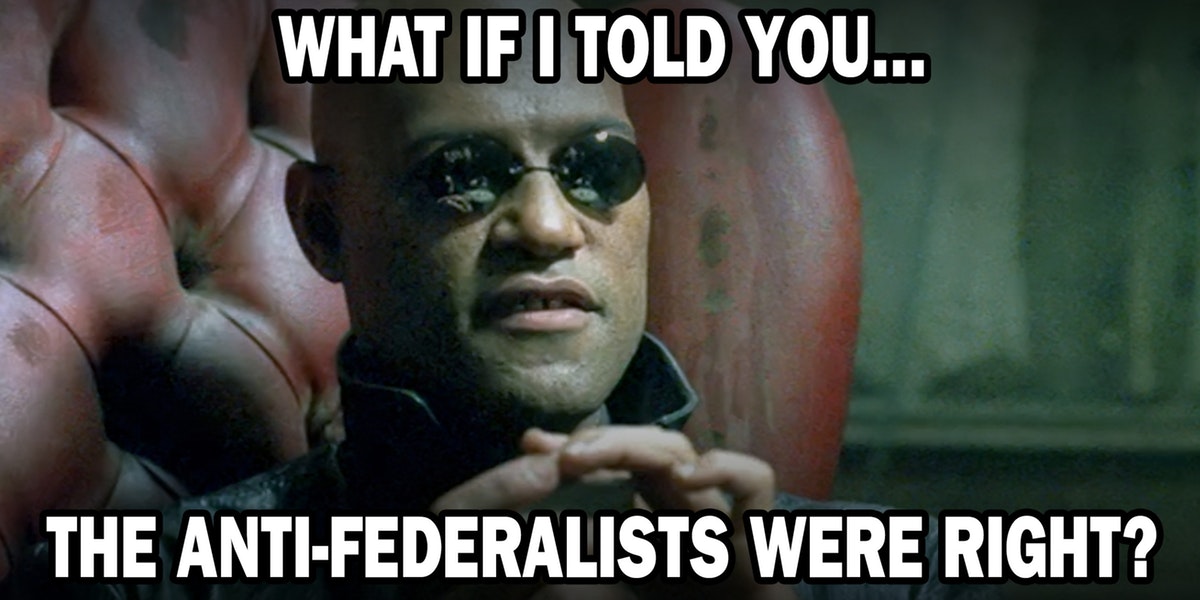
How, according to Tulis and Mellow, has the antifederalist tradition outlived the founding debates? What do you think are the best (and worst) elements of this tradition?
 Constitutional Law (Powers): Spring 2020
The antifederalist tradition managed to outlive the founding debates by usurping the arguments the federalist used to ratify the constitution. According to the authors, both the federalist and antifederalist were aware that the proposed constitution was intended to nationalize the politics of the United States. Those in favor of the constitution named themselves federalist, despite supporting a nationalist policy, to better market the constitution to the American people. This would allow the antifederalist to make the argument that the constitution was meant to resemble a traditional federal system, where the states held equal or greater power than the national government. Moreover, the antifederalist took advantage of the phrase, “separation of powers”, to attempt to limit the powers of the national government. The framers of the constitution did not define the phrase as Montesquieu had done, instead they applied a new definition described as “mixed democracy”. The different branches of government would have overlapping and competing powers, as opposed to defined powers and roles.
The worst elements of the antifederalist legacy is that it has corrupted the discourse over how the founders viewed the constitution. Both liberals and conservatives can legitimize their policies by citing either federalist or antifederalist arguments and still claim that their policy is in line with the constitution. A positive takeaway from the antifederalist tradition is that the issue of state’s rights is still discussed, even though the antifederalist predicted that the constitution would have rendered the states obsolete.
LikeLike
Excellent, Pablo – thanks for this!
LikeLike
The Anti-Federalist movement, during the conception of the Constitution in the late-eighteenth century, opposed the doctrine of “big government”—or, as far as the United States was concerned, a supreme federal government that controlled local sociological institutions. Although the Constitution was ratified in 1788, the original Anti-Federalist movement, according to Tulis and Mellow, managed to outlive the founding debates by morphing into a “legitimate” mode of constitutional interpretation. This metamorphosis from movement to constitutional interpretation was achieved via a three-step process, which sought to “appropriate” (or, in other words, “handpick”) sections of ‘The Federalist’ in order to “[shape] American political development.” That process, to paraphrase Tulis and Mellow, was as follows: 1) the Anti-Federalists met the ratification of the Constitution with heavy criticisms and denunciations; 2) in response to these Anti-Federalist criticisms, the Federalists “downplayed” their intentions for the Constitution prior to “shifting to a subtle defense” of those exact intentions; and 3) after the Constitution was ratified, the Anti-Federalists appropriated portions of the ‘The Federalist’ in order to establish an argument for a particular constitutional interpretation. Perhaps not their original objective, the Anti-Federalists “acted purposefully and strategically when deploying the Federalists’ own rhetoric against the [Constitution].” These methods afforded “authority and influence” to the Anti-Federalist interpretation of the Constitution, which lambasted the proposed document as a “radical and dangerous [departure] from existing political practices.” As such, Thomas Jefferson, using his political influence, helped to transform the Anti-Federalist movement into a “states’ right tradition within American political culture.” This ideology is still prevalent in modern American society, particularly amongst conservative Supreme Court justices (including Thomas and Scalia), who (perhaps unbeknownst to them) employ a view of the Constitution that closely aligns with that of the original Anti-Federalist movement.
Based on Tulis and Mellow’s writing and prior knowledge, the elements of the Anti-Federalist tradition that I hold in the highest regard include the necessity of a “bill of rights,” as well understandings of the detrimental implications of big government and the conception that “individual rights would be insecure and indeed threatened altogether by the likelihood of governmental tyranny” due to a consolidation of political power. As it follows, the need for individual states’ rights is crucial in preventing federal government from evolving into a monarchy-like state.
LikeLike
Excellent response, Eric. I particularly like your breakdown of Tulis and Mellow’s historical argument about appropriation by antifederalists. Nice work!
LikeLike
The Anti-Federalist movement, during the conception of the Constitution in the late-eighteenth century, opposed the doctrine of “big government”—or, as far as the United States was concerned, a supreme federal government that controlled local sociological institutions. Although the Constitution was ratified in 1788, the original Anti-Federalist movement, according to Tulis and Mellow, managed to outlive the founding debates by morphing into a “legitimate” mode of constitutional interpretation. This metamorphosis from movement to constitutional interpretation was achieved via a three-step process, which sought to “appropriate” (or, in other words, “handpick”) sections of ‘The Federalist’ in order to “[shape] American political development.” That process, to paraphrase Tulis and Mellow, was as follows: 1) the Anti-Federalists met the ratification of the Constitution with heavy criticisms and denunciations; 2) in response to these Anti-Federalist criticisms, the Federalists “downplayed” their intentions for the Constitution prior to “shifting to a subtle defense” of those exact intentions; and 3) after the Constitution was ratified, the Anti-Federalists appropriated portions of the ‘The Federalist’ in order to establish an argument for a particular constitutional interpretation. Perhaps not their original objective, the Anti-Federalists “acted purposefully and strategically when deploying the Federalists’ own rhetoric against the [Constitution].” These methods afforded “authority and influence” to the Anti-Federalist interpretation of the Constitution, which lambasted the proposed document as a “radical and dangerous [departure] from existing political practices.” As such, Thomas Jefferson, using his political influence, helped to transform the Anti-Federalist movement into a “states’ right tradition within American political culture.” This ideology is still prevalent in modern American society, particularly amongst conservative Supreme Court justices (including Thomas and Scalia), who (perhaps unbeknownst to them) employ a view of the Constitution that closely aligns with that of the original Anti-Federalist movement.
Based on Tulis and Mellow’s writing and prior knowledge, the elements of the Anti-Federalist tradition that I hold in the highest regard include the necessity of a “bill of rights,” as well understandings of the detrimental implications of big government and the conception that “individual rights would be insecure and indeed threatened altogether by the likelihood of governmental tyranny” due to a consolidation of political power. As it follows, the need for individual states’ rights is crucial in preventing federal government from evolving into a monarchy-like state.
LikeLike
Federalists believed that the Constitution does not need a Bill of Rights because all the powers that are not given to the federal government are reserved by the states. On the other hand, Anti-Federalists argued that the Bill of Rights is necessary to protect the liberty of the states. According to Tulis and Mellow, Anti-Federalists won the long run. Indeed, many Americans’ understanding of the Constitution is limited to the Bill of Rights. As many people oppose to Jeffersonian politics, I am inclined to think that he might have been right. Maybe the central government really is a great threat to American liberty? Obamacare was mentioned in this text. Clearly, it is unconstitutional for the central government to get involved in something which is actually the power of the states. Even though I always thought Fereralists did such a great job, after reading this article, I should probably agree with the picture above.
LikeLike
The antifederalists strongly adjusted their fight to push their agenda after ratification, thereby outliving much of the founding debates. Not only did the antifederalists push for constitutional interpretation to allow for their ideas to apply, they embedded the states’ rights issue central to the antifederalist movement into American political culture. The antifederalist agendas were still endorsed through constant questioning of the ratification. For example, an antifederalist, Brutus, challenged the Supreme Court’s overarching power over policy decisions and its potential to abuse it. The federalist then shifts the Supreme Court’s power over from broad policy decisions to strong judicial review of the constitutionality of legislation, which supported the antifederalist idea of separation of powers. The antifederalist tradition outlived the founding debates when discussing the New Deal legislation—contesters claimed that national government held too much power. Federal power is large, but states still hold a vast amount of power. The issue of limited government continues in American political culture, as an emblem of individual rights and freedom.
Antifederalists worried about the potential abuse of power performed by the national government and the states’ complete dependence over national government. These worries helped them establish one of the best elements of the tradition: ensuring that individual rights would be secure and unaffected by governmental tyranny. They did so by advocating for precision in how national government was going to subject their power onto the states and people. The federalists’ ambiguous framework of nationalization was frequently questioned by the antifederalists’, which pushed for more precision in the Constitution and made the document more comprehensible. The antifederalists’ skepticism towards nationalization, on the other hand, can strain peoples’ trust in national government and discourage political participation, which can damage how people are governed.
LikeLike
Gleo, this is great. I’m particularly happy that you mentioned the critiques of the Supreme Court by antifederalists. We’ll discuss this more in class.
LikeLike
The Anti-Federalist incessant proposal to avoid mixed sovereignty is why the tradition has lived beyond their defeat. If a society is going to have multiple levels of government and have a sense of equality between them, then clear boundaries must be drawn. Otherwise, the balance of power between the federal and state government would be left entirely to good faith. There would be no reason to write hundreds of books and judicial opinions if this was possible. As the Anti-Federalists pointed out, one mixture will become dominant. On the flip side, the Anti-Federalists’ fear of the “necessary and proper clause” has problems. While they advocate for clear boundaries between the federal and state, they don’t allow for supreme power within those established boundaries. Unless this exertion of power violates a person’s rights (which would be a failure of duty) then why would the government not be able to what is needed to fulfill its duties?
LikeLike
According to Tulis and Mellow, the Anti-Federalist tradition has outlived the founding debates by many presenting themselves as modern day Federalists with “rhetorical appropriation.” The authors describe rhetorical appropriation as when people frame arguments presented by eighteenth century Federalist writers as supporting their modern day arguments that are actually more in line with what the eighteenth century Anti-Federalists would have argued. The worst element of this tradition is that it is not straightforward, and the arguments become convoluted and complicated due to the rhetorical appropriation that Tulis and Mellow write about. I understand why people would be hesitant to call themselves “Anti-Federalists,” as the authors pointed out the name made the group seem like the enemy, yet using quotes from founding fathers to justify a way of thinking that they did not support makes things unnecessarily complex and untrustworthy, since they are using phrases out of context. The best element of this tradition is that people are continuing to make important arguments that make valid points about subjects like the vast power of the federal government. It is healthy for a democracy to have a certain extent of disagreements between groups.
LikeLike
According to Tulis and Mellow, the Antifederalist tradition has outlived the founding debates because they have an antistatist interpretation of the Constitution which was legitimized which allowed for this interpretation to be used by Andrew Johnson and Barry Goldwater. The Antifederalist was also worried about the fact that states would lose sovereignty over time as the new Constitution had allowed for a central authority to be sovereign. In addition, they have also outlived the founding debates as most of Americans understanding is limited to the Bill of Rights as well as the concern in today’s world that the national government may have too much power. I think the best element of this tradition is that in some ways, I do belive that the national government has too much power especially since government officials often make false promises to get into office and many of the things that people do not like are still in contention while the worst element of this tradition is to assert that since Americans understanding is limited to the Bill of Rights is good evidence that the Antifederalist has won.
LikeLike
According to Tulis and Mellow, the Anti-Federalist tradition was able to survive and outlast the founding debates. Tulis and Mellow show us readers how the Anti-Federalists re-interpreted the Constitution so that it would work in their favor. “They disagreed over its merits, not over its logic.” In a sense, they outlived the founding debates through the appropriation of the Constitution. Although the Federalists “won” with ratification, the Anti-Federalists were the real winners as they were victorious in securing the Bill of Rights. One of the best elements of the Anti-Federalist traditions is their argument that the Constitution gave the national government too much power and centralized power. Executive power has grown and expanded up until the current day and it’s clearly evident that our President holds a surplus amount of power. One of the worst elements of the tradition is that they consider the Constitution to be “vague.” The Constitution in a way laid the framework for the creation of the government and law and can be inexplicit at times, but I do consider that it did do its objective.
LikeLike
According to Tulis and Mellow, the Federalists and the Anti- Federalist had a great conflict over the ratification of the Constitution. Federalists believed that changing the Articles of Confederation to the Constitution would provide a strong central government for the people. The anti-federalists stressing the importance of not giving to much sovereignty to one central government is due to the fear of making the states look less powerless. This can lead to tyranny and eventually the states collapsing. The anti-federalist traditions are mostly landowners who thought that a weak federal government is the source of liberty. The anti-federalists feared that the Constitution would take away their individual freedom. Therefore, as a compromise, the federalists introduced the Bill of Rights. The best element of this tradition was the fact that individual liberty is granted through the Bill of Rights. The anti-federalists fighting to make sure that individuals and states still have power is what we people want. Individual liberty is what mattered. Not only that, the fact that the constitution was primarily “vague and inexplicit” when it came to providing equal power within individuals and within states, the anti-federalists feared that abuse of power will be a big issue. However, the worst element of this tradition would be that if states are given more power than the central government, the unity between states wouldn’t be there. The federalists wanted to make sure that the states would be united together under one central government if not conflicts within states would rise. Therefore, having a strong contract is essential to keep everything in order.
LikeLike
According to Jeffrey K. Tulis and Nicole Mellow the tradition of the Anti-federalist are outliving the founding debates because there is room for interpretation. Although, it may appear that the Anti-federalist have lost many of the battles they are able to alternate meanings of the constitution to their interpretation. As stated on page 3 of the reading, “They sought to reclaim through interpretation what they had lost through constitutional construction and ratification.” The Anti-federalist’s rhetoric analysis for their contradictions against this new form of regime were based on the merits of the constitution not on its logical development.
As laid out in the text, through certain merits such as granting the national government with much power, that would eventually annihilate State and local governments. This in essence is a controversial topic because if the State can’t resolve an issue that is affecting the public it should be taken upon a higher authority to be resolved.
This is quintessential, as for the importance of a federal government. Certain issues such as Healthcare should not lie in the hands of the States as the Federal Government has more authority to oversee a greater population this issue should be an issue of their interest and is still unresolved.
I believe that the way the authors portrayed the ideas of the Anti-federalist against the implications of this new regime were thoroughly explained and alludes to certain main points still occurring. This tradition can desire for a change of the entire constitution and forming a new one, but can also have concrete interpretations without room for change which is much more dangerous than the one already written.
LikeLike
According to Tullis and Mellow the Anti-federalists tradition has been outlived since the founding debates, because looking at the debates within the American government, the Republican party and also the very minuscule, libertarian party have made their parties’ sole purpose to keep the government as small as possible. Examples of this would be when Republicans tout restricting gun laws and having fewer taxes. There are many advantages and disadvantages of being an Anti-federalist; one advantage would be that it ends up having more people participate in politics. If the national government is not making the rules and regulations you will ultimately end up having smaller forms of government creating legislation instead. That’s what the antifederalist believe would be an advantage within their ideologies. A disadvantage of being an antifederalist would be since states would have more power, their own localized government such senators and governors the people will lean more on them instead of the federal government. This will lead to some states becoming more successful than others. For example, one state will begin to use its resources for more useful entities like their education system while others will use it for things less directly useful like their military budget.
LikeLike
Thanks for this Sabreen. A particularly nice commentary on the costs and benefits of strong states
LikeLike
The Anti-Federalist tradition outlived the founding debates because the Anti-Federalists were able to create an interpretation of the constitution that goes against its logic. Anti-Federalists used The Federalist as a source of understanding the consequences of having a constitution which gave them an opportunity to change the constitution. Even though the Federalists succeeded in ratifying a constitution, the Anti-Federalists opted for a long term strategy to change the constitution. Anti-Federalists would find issues with the Federalist and the Constitution and complain about it and Federalists would change the constitution so it agrees with Anti-Federalist ideas. I think an element that is beneficial to Anti-Federalist tradition is complaining about the constitution. It is beneficial because parts of the constitution that are against Anti-Federalist ideas can be changed.
LikeLike
According to the authors, the anti-federalist beliefs have outlived the traditional founding debates, as anti-federalist “lost the political war over the ratification of the Constitution in 1788, but they and their heirs have won many subsequent battles regarding the interpretation of the Constitution in practice.” (p.66) The chapter establishes how the Federalist Papers presented a counter-argument to almost every anti-federalist discourse on how the Constitution was, in fact, flaw. The best element of the Federalist tradition would be the explanation of the separation of powers. However, the worst tradition was the lack of foresight in States’ rights as it would as “the states would have virtually no role in the operation of the national authority.” (p.48)
– Martin B. (PSC21200)
LikeLike
According to Tulis and Mellow, anti federalist tradition has outlived the founding debates by appropriation. This appropriation is what has shaped American political development. Tulis and Mellow explain that “the anti federalists in their failed effort to defeat the Constitution made possible their subsequent significant success in informing constitutional interpretation”.(p. 31) The best of this element is how anti federalist had little but important small wins in the writing of the Constitution such as the addition of the Bill of Rights, protection of individual rights. The goal was not individual rights but mainly the restoration of power to states and local government. The worst of this tradition is that federalist did adopt the bill of rights but its amendments were different from those preferred by the anti ferderalist.
LikeLike
According to Tulis and Mellow, the antifederalist tradition has not outlived the funding debates mainly because American politics is heavily based on how the constitution is interpreted. The Anti-Federalists were concerned more how difficult it can be to change or advance certain amendment as well as giving more power to the states. The Federalists declared themselves not as nationalists to show that power would not come from one source but it would be separated. From the day the constitution was ratified to today, there are many issues and debates about what states can do, what the federal government can do, and their limits. This can get extremely confusing mainly because the constitution implies a two party system which established platforms that candidates may or may not strictly follow. For example, Thomas Jefferson, one Anti-federalist/republican, who was concerned about not expanding the scope of the federal any further, bought land which further developed the USA’s economy and posed further questions about the creation of new states. This brings the question of whether certain roles within the constitution like the President, should expand one’s powers despite their party affiliation.
LikeLike
The Anti-Federalist were right due to the fact that the federal government has upended certain laws and interfered with the state government’s power. For example, New York has committed itself to help with women reproduction services, but yet the federal government wished to pull back funding for procedures they don’t agree with. At the beginning of the reading, they talk about the Federalists actually are nationalists because of the idea of preserving greater state power in a federal system but yet the government overrides certain laws the states put in place. We are witnessing today how the federal government is not upholding the constitution when it comes to separation of powers. The constitution allowed separation of power so that the three branches of government would be in conflict with each other not side with each other. The Senate is supposed to push back on the Executive branch which crosses the line and abuses its power, by taking money allocated by Congress to be for something and it is appropriated to something else.
LikeLike
The anti-federalist tradition has outlived the founding debates according to Tulis and Mellow because the anti-federalist ideas and opinions have “layered over” the federalist design. The opposition party, according to Tulis and Mellow, uses anti-federalist arguments so that the party in power can not centralize or nationalize their policy. The anti-federalist ideas have also succeeded in arguing that the central government would have many unchecked powers and it created a sort of “hybrid” government frame. The anti-federal and federal ideologies mix in ways that have resulted in today’s national government. The ideas of anti-federalists are still alive and used when people do not want the federal government to further their agenda upon the states and local governments. The good part about the anti-federalist tradition outliving founding debates is that the arguments make sense and it helps to balance the national body. The bad thing is that it is a threat to the constitution in ways because it implies necessary change.
LikeLike
Antifederalists had the belief that they wanted a separation of powers and a less central government that would be in the hands of the states. According to Tulis and Mellow, the antifederalist tradition has outlived the founding debates. “The Federalists and leading Anti-federalists shared a view of constitutional interpretation that is strikingly different from conventional approaches today, including the views of those who invoke them” (42). Nowadays, the antifederalists’ beliefs aren’t as strong as they were before. Americans present themselves as an advocate of Constitution, shifting towards a Federalist position. They view the Constitution as a safe haven because it has been embedded in our politics. The Constitution has an addition that protects individual liberties and ensures that the central government has a balance of powers that would not clash with state powers. I believe that the best element of the antifederalist tradition is that they had this core belief that the central government would end up becoming a corrupt tyrannical monarchy like Great Britain and were worried about the lack of protection for the individual citizens in the Constitution.
LikeLike
A valid argument that remains relevant today by the Anti-Federalist is that of centralized power. The idea that the executive will become too powerful and over bearing as opposed to the average citizen. Another argument by the Anti-Federalists according to Tulis and Mellow was that the separation of powers was an essential element against tyranny. Also, that the constitution was vague and implicit; this vagueness of the constitution remains a common theme in judicial proceedings as well as impeachment proceedings.Yet another argument that the Anti-Federalist emphasized is the view that the constitution should not be interpreted exactly, mainly by progressives, and the idea to limit the power of centralized government, letting states decide their respective local matters. A large success of this old debate was the adoption of both Federalist and Anti-Federalist traditions, such as the balance of powers, as well as allowing states to establish their own laws and tax systems.
LikeLike